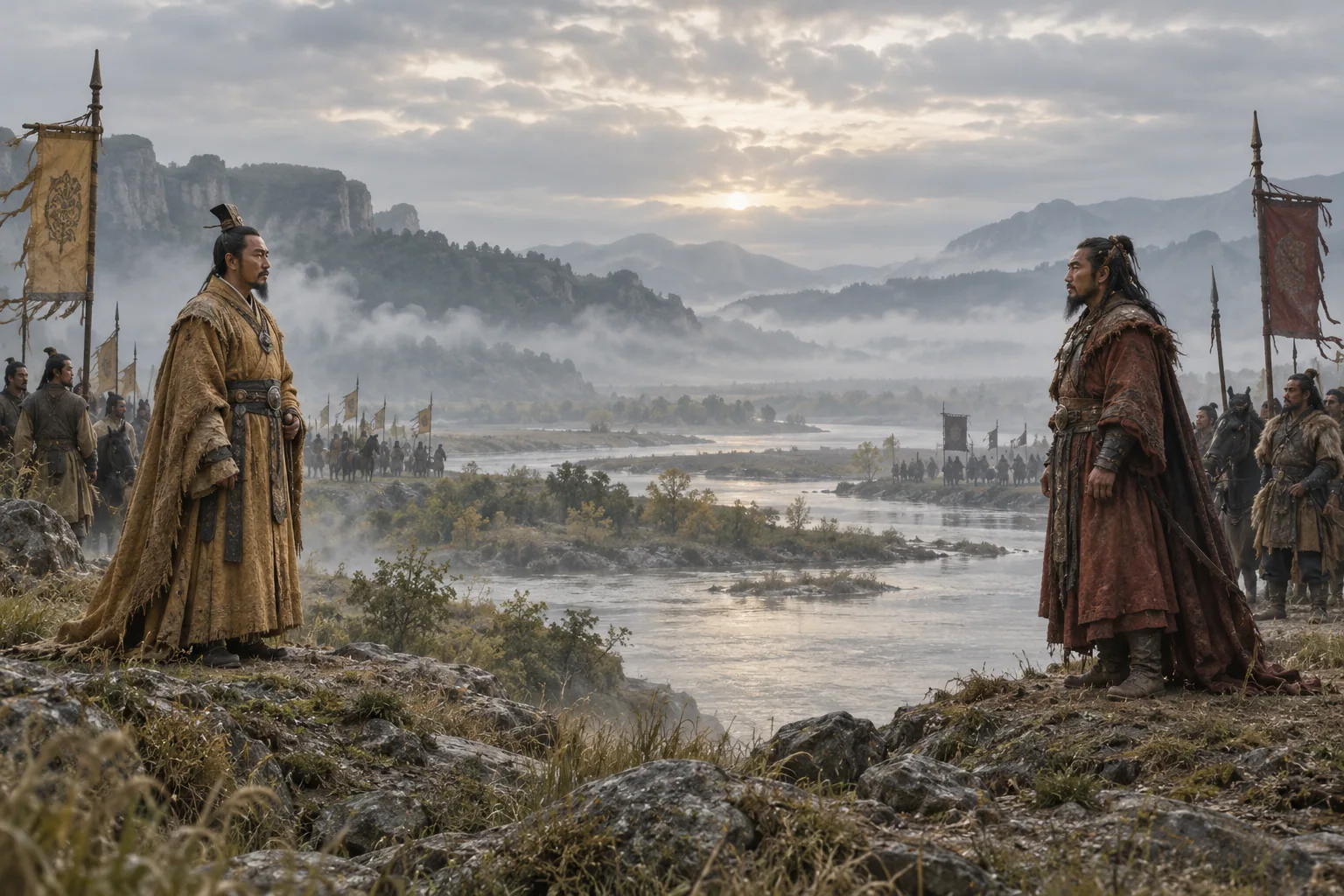
Ancestors & conflict
Huangdi, Chiyou & the battle of Zhuolu
Two powerful leaders meet in a conflict retold as both ancestral history and a struggle of wind, rain and drought.
Read the storyMYTH, MEMORY & WONDER
中国神话 Zhōngguó shénhuà
Before the first sunrise. Beyond the last mountain. Meet the stories that gave a world its shape.
Explore the stories
01 / FIND YOUR BEARINGS
Chinese mythology is a conversation across centuries: creation stories, strange beings, local gods, celestial journeys and very human hopes.
Begin with widely shared stories, then explore Zhuang, Miao and Bunu Yao origin traditions in their own settings. This is a broad introduction, not an exhaustive collection of every local epic.
There is no single sacred book or universal family tree. The same figure may change between an ancient text, a temple tradition and a modern novel or film.
World-making, floods and extraordinary beings in texts such as the Classic of Mountains and Seas and Huainanzi.
Local worship, Daoist immortals and Buddhist figures, with distinct traditions that still matter to communities today.
Journey to the West, Investiture of the Gods and later legends give older figures new lives, motives and relationships.
02 / THE STORY COLLECTION
Each entry includes its background, narrative, interpretation, variant traditions and sources. Explore eight themes, or search for a figure by name.
Ancestors & conflict
Two powerful leaders meet in a conflict retold as both ancestral history and a struggle of wind, rain and drought.
Read the story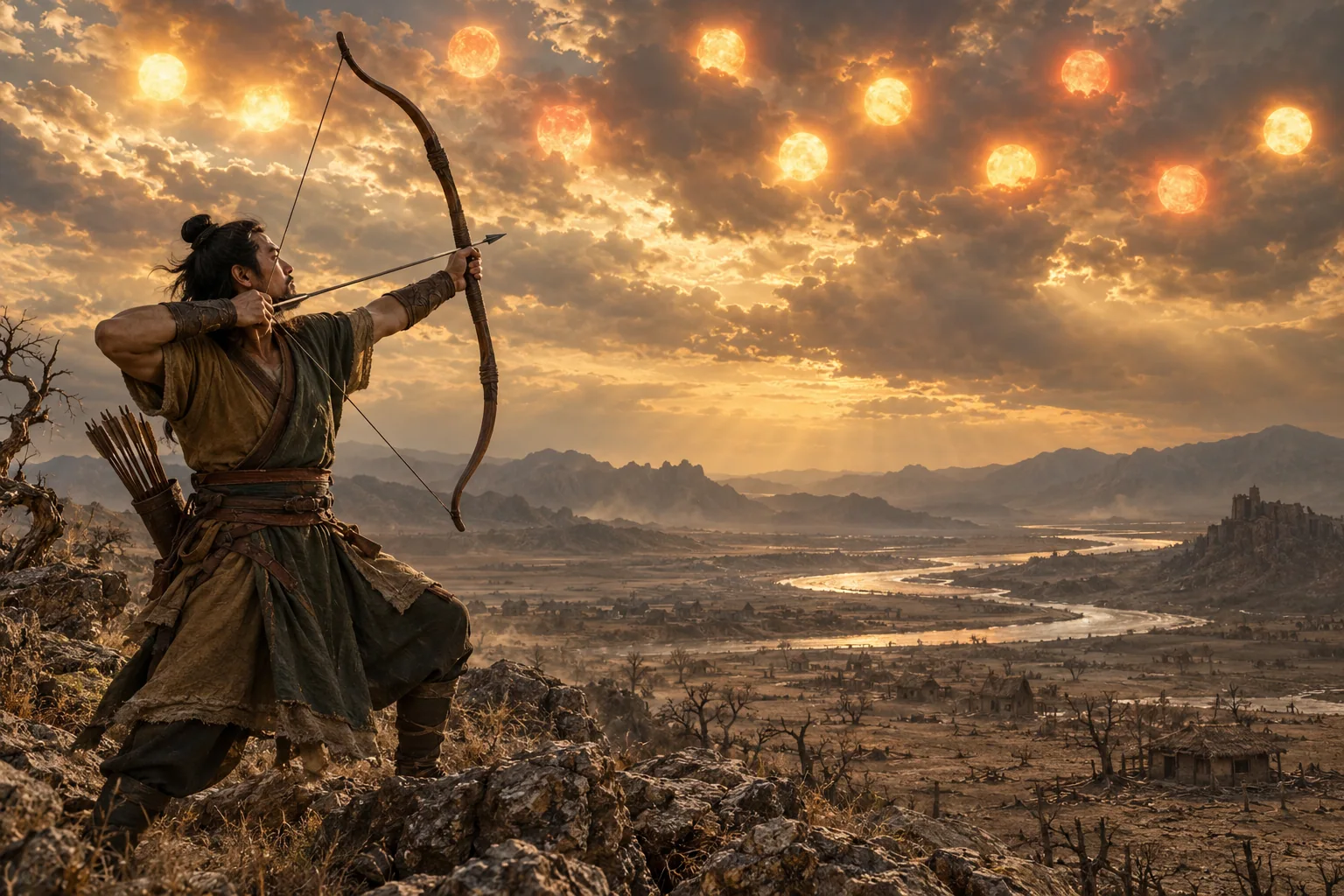
Sky & stars
An archer confronts a sky whose overwhelming heat is destroying life below.
Read the story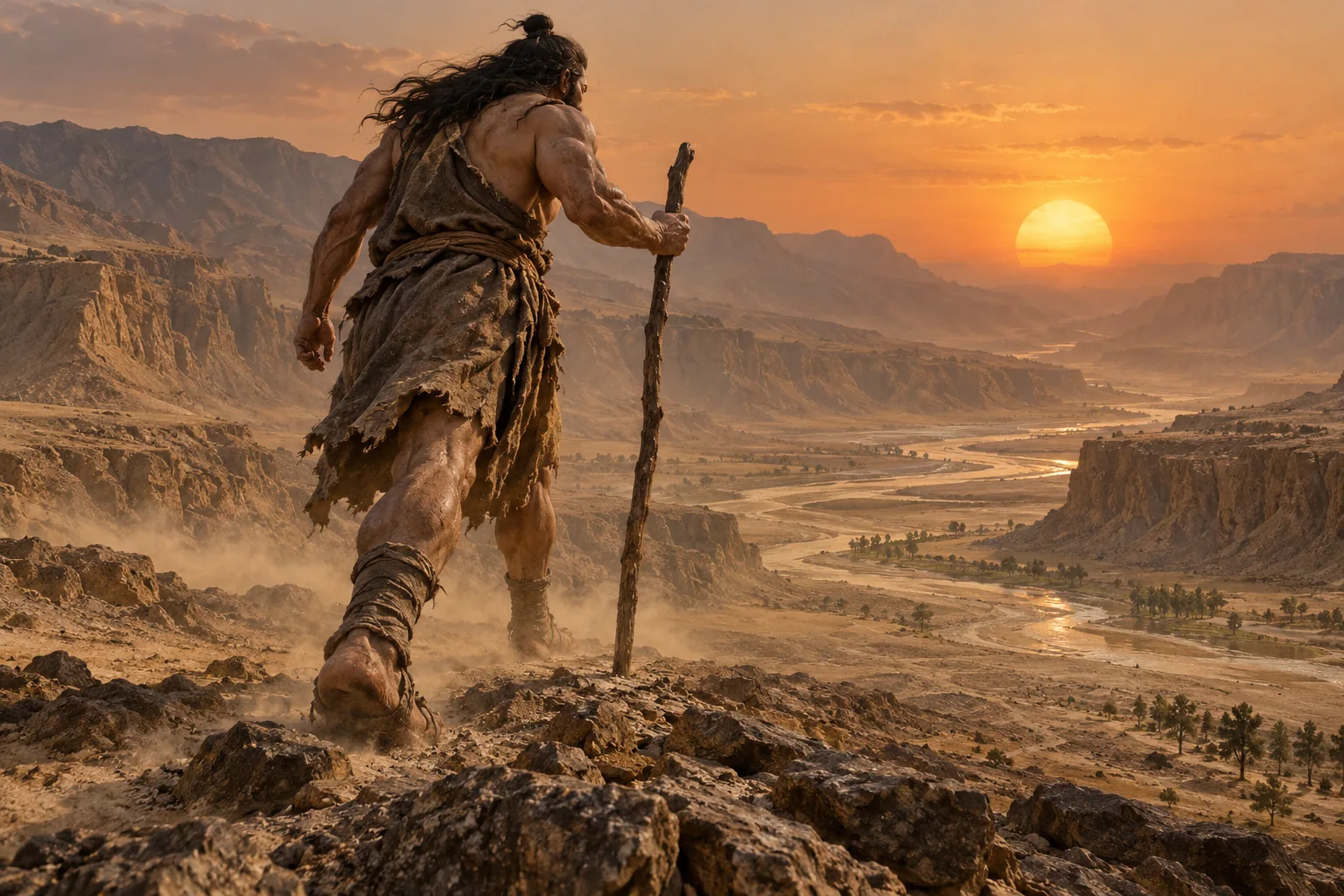
Nature & perseverance
A giant pursues the sun beyond the limits of his own strength.
Read the story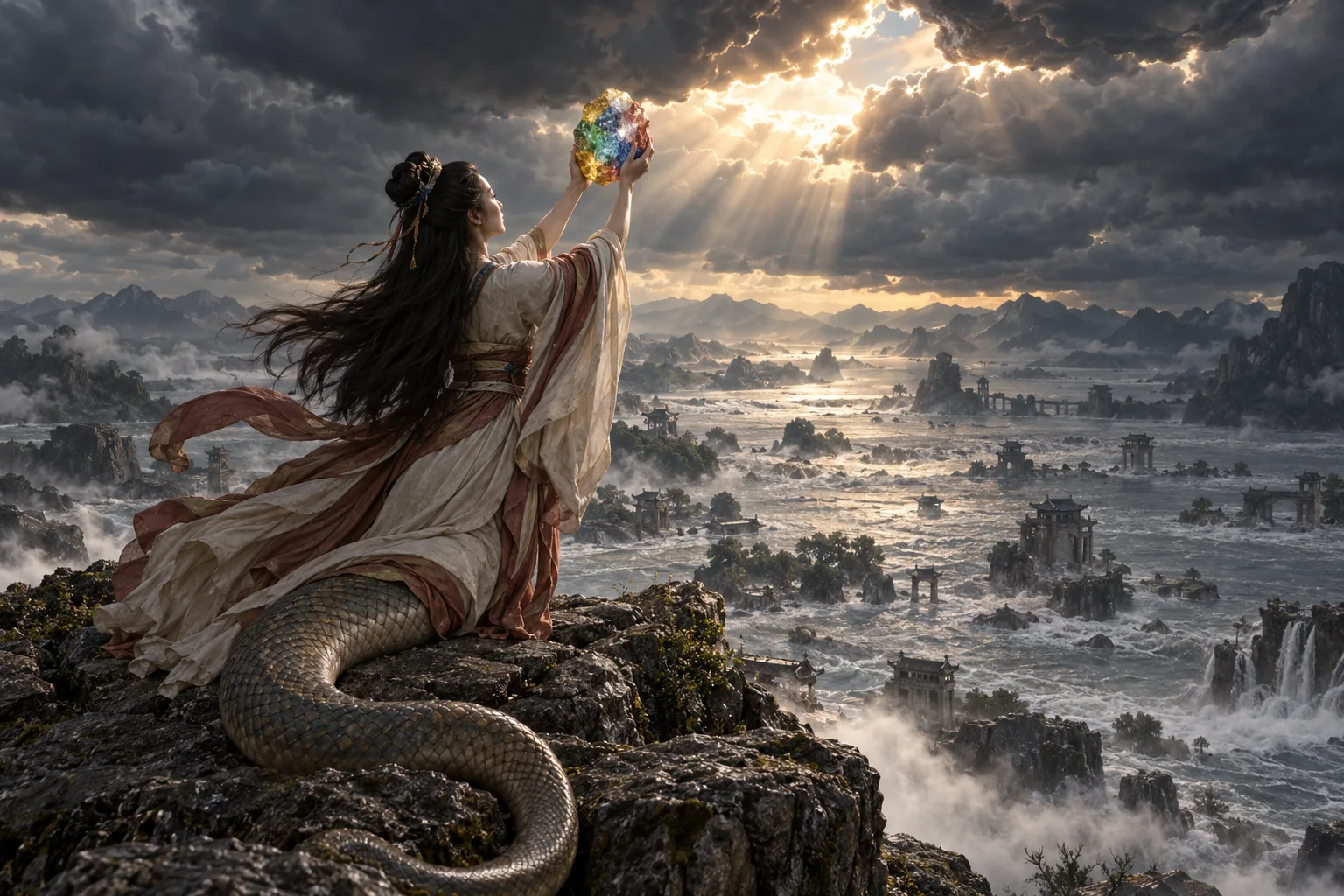
Origins & creation
When the world falls out of balance, Nüwa repairs the heavens with five-colored stones.
Read the storyOrigins & creation
盘古开天 Pángǔ kāitiān
A giant separates heaven from earth, making room for a world to begin.
Read the storyOrigins & creation
女娲补天 Nǚwā bǔtiān
When the world falls out of balance, Nüwa repairs the heavens with five-colored stones.
Read the storySky & stars
后羿射日 Hòuyì shèrì
An archer confronts a sky whose overwhelming heat is destroying life below.
Read the storySky & stars
嫦娥奔月 Cháng’é bēnyuè
An elixir grants immortality, but carries Chang’e far from the human world.
Read the storyNature & perseverance
精卫填海 Jīngwèi tiánhǎi
A tiny bird carries twigs and stones against the immensity of the sea.
Read the storyNature & perseverance
夸父逐日 Kuāfù zhúrì
A giant pursues the sun beyond the limits of his own strength.
Read the storyNature & perseverance
大禹治水 Dà Yǔ zhìshuǐ
Yu gives the waters a path, turning a flood story into a model of public duty.
Read the storyOrigins & creation
共工触山 Gònggōng chùshān
A broken cosmic support explains a tilted sky and the course of the waters.
Read the storyHeroes & legends
孙悟空 Sūn Wùkōng
A stone-born rebel finds a different kind of strength on a long pilgrimage.
Read the storyHeroes & legends
哪吒闹海 Nézhā nàohǎi
A fierce young protector passes through conflict, sacrifice and a lotus rebirth.
Read the storySky & stars
牛郎织女 Niúláng Zhīnǚ
Two lovers, separated by the celestial river, meet across a bridge of magpies.
Read the storyHeroes & legends
白蛇传 Báishé Zhuàn
A transformed snake spirit’s love asks where the boundary of humanity lies.
Read the storyAncestors & conflict
涿鹿之战 Zhuōlù zhī zhàn
Two powerful leaders meet in a conflict retold as both ancestral history and a struggle of wind, rain and drought.
Read the storyAncestors & conflict
阪泉之战 Bǎnquán zhī zhàn
A rivalry between ancestral rulers becomes part of the later language of shared origins.
Read the storyCulture & inventions
伏羲画卦 Fúxī huà guà
Patterns in the sky, earth and living bodies become a language for thinking about change.
Read the storyOrigins & creation
女娲造人 Nǚwā zàorén
A creator gives ordinary earth a human shape, in a tradition distinct from mending the sky.
Read the storyCulture & inventions
神农尝百草 Shénnóng cháng bǎicǎo
An agricultural teacher tests the world’s plants, making nourishment and danger part of the same story.
Read the storyCulture & inventions
钻木取火 Zuānmù qǔhuǒ
A flame transforms the preparation of food and the way a community lives.
Read the storyCulture & inventions
有巢氏 Yǒucháoshì
Wooden shelter offers a vulnerable human community a different relationship with the wild.
Read the storyCulture & inventions
仓颉造字 Cāngjié zàozì
The invention of writing is imagined as an event so momentous that heaven and spirits respond.
Read the storyCulture & inventions
嫘祖始蚕 Léizǔ shǐ cán
A silk origin legend remembers the patient work of raising silkworms and turning cocoons into cloth.
Read the storyAncestors & conflict
刑天舞干戚 Xíngtiān wǔ gānqī
A defeated warrior continues to brandish shield and axe after losing his head.
Read the storyNature & perseverance
鲧盗息壤 Gǔn dào xīrǎng
Before Yu channels the flood, his father tries to hold it back with a miraculous earth.
Read the storyAncestors & conflict
应龙与女魃 Yìnglóng yǔ Nǚbá
Divine helpers win a battle, but cannot leave the human world unchanged.
Read the storyImmortals & guardians
西王母 Xīwángmǔ
A formidable mountain being becomes one of the most influential images of divine authority and long life.
Read the storySky & stars
羲和浴日 Xīhé yù rì
Before the archer’s crisis, the suns belong to a family and a landscape of their own.
Read the storySky & stars
常羲浴月 Chángxī yù yuè
A short ancient passage imagines the moons as the children of a celestial mother.
Read the storySky & stars
烛龙 Zhúlóng
Day, night and the seasons follow the body of a vast serpent-like being.
Read the storyNature & perseverance
鲲鹏之变 Kūnpéng zhī biàn
A vast fish becomes a vast bird, and ordinary measures of distance suddenly seem too small.
Read the storyNature & perseverance
愚公移山 Yúgōng yí shān
An old man’s plan outlives a single lifetime—and eventually moves the gods.
Read the storyImmortals & guardians
八仙过海 Bāxiān guò hǎi
Eight travelers face the same sea and find eight different ways across it.
Read the storyNature & perseverance
鲤跃龙门 Lǐ yuè Lóngmén
An upstream passage becomes the threshold between an ordinary fish and a dragon.
Read the storySky & stars
吴刚伐桂 Wú Gāng fá guì
Each axe stroke closes behind the blade, leaving a task that can never be completed.
Read the storyImmortals & guardians
钟馗捉鬼 Zhōng Kuí zhuō guǐ
A fearsome-looking figure turns his strength toward protecting households from harm.
Read the storyImmortals & guardians
妈祖护海 Māzǔ hù hǎi
Memories of a compassionate woman grow into a living maritime tradition.
Read the storyHeroes & legends
姜子牙封神 Jiāng Zǐyá fēng shén
A war of dynasties becomes a supernatural struggle that reorganizes the divine world.
Read the storyCulture & inventions
后稷教稼 Hòujì jiào jià
An extraordinary child becomes the agricultural ancestor remembered by the Zhou.
Read the storyRegional origin traditions
布洛陀 Bùluòtuó
Origin narratives, ritual knowledge and community order meet in a many-voiced Zhuang tradition.
Read the storyRegional origin traditions
蝴蝶妈妈 Húdié māma
A maple tree, a butterfly and a bird connect life across different forms.
Read the storyRegional origin traditions
密洛陀 Mìluòtuó
A maternal creator anchors an epic about the beginnings of the world and human life.
Read the storyTry an English name, Chinese characters or pinyin without tone marks.
03 / WHO’S WHO
A reading companion, not a fixed pantheon. Follow a story link to meet a figure in context.
盘古 Pángǔ
The giant of a creation tradition who separates heaven and earth. Accounts of his body becoming the landscape add a second way of imagining the world’s origins.
Pangu opens the world女娲 Nǚwā
Known for repairing heaven and, in separate traditions, creating people. Serpent-bodied images and her pairing with Fuxi connect her to the ordering of life.
Nüwa mends the sky伏羲 Fúxī
A legendary culture hero associated with the eight trigrams and the beginnings of human arts. Often paired with Nüwa in art; their precise relationship varies by tradition.
Fuxi observes the world神农 Shénnóng
Shennong is associated with farming and the testing of plants. Often identified with the Flame Emperor in later traditions, the two names should not be treated as interchangeable in every early text.
Shennong tastes the plants黄帝 Huángdì
A legendary ruler linked to cultural inventions and conflict with Chiyou. Ancestor traditions and accounts of early history overlap here; legendary reign dates are not secure historical dates.
Huangdi, Chiyou & the battle of Zhuolu西王母 Xīwángmǔ
Early descriptions give her formidable animal features; later art and stories often show a regal immortal associated with peaches and the west. “Wangmu” is not always the same character in every work.
The Queen Mother of the West后羿 Hòuyì
The archer who relieves the catastrophe of many suns, commonly linked with Chang’e. Early references to Yi and historical-legendary Hou Yi require care rather than one combined biography.
Hou Yi and the ten suns嫦娥 Cháng’é
Her ascent after taking an elixir makes the moon a place of longing. Her motivation and even her lunar form differ across the long history of the story.
Chang’e flies to the moon共工 Gònggōng
A powerful figure associated with water. His collision with Mount Buzhou explains the damaged supports of the world in a well-known Huainanzi account.
Gonggong strikes Mount Buzhou大禹 Dà Yǔ
A flood-taming culture hero and legendary founder of the Xia. Ethical accounts emphasize service and labor; other texts supply divine and fantastic episodes.
Yu tames the flood精卫 Jīngwèi
A drowned girl transformed into a bird that carries wood and stones to the sea. The girl 女娃 is distinct from the goddess 女娲.
Jingwei fills the sea夸父 Kuāfù
A giant whose pursuit of the sun ends in overwhelming thirst. His story has supported both admiration of great ambition and reflection on its limits.
Kuafu chases the sun玉皇大帝 Yùhuáng Dàdì
A major heavenly ruler in popular religion and many later stories. The bureaucratic court familiar from fiction is one influential image, not a universal hierarchy for all Chinese traditions.
Sun Wukong, the Monkey King孙悟空 Sūn Wùkōng
The Monkey King of Journey to the West, recognized by his transformations and iron staff. His journey turns a challenge to heaven into the demanding work of protecting a pilgrimage.
Sun Wukong, the Monkey King哪吒 Nézhā
A youthful deity whose lotus rebirth and magical weapons are especially familiar through Investiture of the Gods. His temple, Buddhist and literary histories reach beyond any one screen adaptation.
Nezha and the Dragon King二郎神 Èrláng Shén
Often depicted with a third eye and a hunting hound. Many later works identify him as Yang Jian, but local cults and earlier accounts preserve other identities.
Sun Wukong, the Monkey King观音 Guānyīn
The Chinese form of the Buddhist bodhisattva Avalokiteshvara. Guanyin appears widely in art, devotion and fiction; calling this figure simply a native Chinese goddess misses the Buddhist background.
Sun Wukong, the Monkey King八仙 Bāxiān
Lü Dongbin, Li Tieguai, Zhongli Quan, Zhang Guolao, He Xiangu, Lan Caihe, Han Xiangzi and Cao Guojiu form the familiar group. Their sea-crossing tale lets each use a different ability.
The Eight Immortals cross the sea龙王 Lóngwáng
Dragon rulers appear in local worship and Buddhist, Daoist and literary settings. The four sea kings are well known from novels, while communities may honor more localized water deities.
Sun Wukong, the Monkey King妈祖 Māzǔ
A sea-protecting goddess rooted in traditions about a woman from Meizhou. Mazu belief remains a living community tradition, especially among coastal and diaspora communities.
Mazu, guardian of sea journeys织女 Zhīnǚ
A celestial weaver and star figure who becomes the heroine of the Cowherd romance. Qixi’s requests for skill recall her work as well as her love story.
The Cowherd and the Weaver Girl白素贞 Bái Sùzhēn
The white snake spirit of later legend, drama and opera. Her portrayal changes from threatening supernatural outsider to sympathetic heroine across retellings.
The Legend of the White Snake蚩尤 Chīyóu
A powerful opponent of Huangdi at Zhuolu. The Shiji frames their conflict as a struggle for rulership; the Shanhaijing gives Chiyou the aid of wind and rain. His identity and reception vary, so defeat in one telling should not become a universal moral judgment.
Huangdi, Chiyou & the battle of Zhuolu炎帝 Yándì
The ancestral ruler opposed to Huangdi at Banquan in the Shiji. Later traditions frequently identify him with Shennong, though titles, individuals and lineages do not always coincide. His daughter Nüwa in the Jingwei story is 女娃, a different name from the creator 女娲.
Yandi, Huangdi & the battle of Banquan仓颉 Cāngjié
The culture hero credited with writing, often cast as Huangdi’s recorder. The Huainanzi makes heaven and spirits react to his invention. His story personifies a long cultural process; it is not a literal account of one person designing the entire Chinese script.
Cangjie gives things written signs嫘祖 Léizǔ
Named in the Shiji as Huangdi’s wife and remembered in later traditions as a founder of sericulture. Her story places skilled work and the care of silkworms within ancestral memory. She is one of several figures associated with silk origins.
Leizu and the beginnings of silk燧人氏 Suìrénshì
A sage who kindles fire and changes the way people prepare food in the Hanfeizi. The text uses this useful invention to discuss the needs of different ages. His title remembers a practice, not an archaeologically established inventor.
Suiren brings fire into daily life有巢氏 Yǒucháoshì
The maker of wooden nest-like shelters in the Hanfeizi’s account of remote antiquity. Protection from dangerous animals brings public recognition, making the construction of a home an act of cultural founding.
Youchao builds a shelter鲧 Gǔn
Yu’s father, whose flood-control work fails in several traditions. The Shanhaijing has him take the growing earth xirang without permission and suffer divine punishment. His role combines rescue, transgression and the unfinished task inherited by Yu.
Gun and the earth that grows祝融 Zhùróng
Associated with fire and the southern direction across traditions, and named as the agent of Gun’s punishment in the Shanhaijing. A deity, an ancestral figure and a title of office can overlap under this name; they should not be flattened into one fixed biography.
Gun and the earth that grows应龙 Yìnglóng
The dragon who aids Huangdi in the Shanhaijing and is connected with water and rain-making. Different passages give different accounts of his deeds and his inability to return above. The winged form familiar in later imagery is part of his reception.
Yinglong, Nüba & the weather after war女魃 Nǚbá
The heavenly woman Ba stops Chiyou’s rain in the Shanhaijing. Unable to ascend afterward, she brings drought where she remains. Her story explains the difficult aftermath of divine intervention; later drought monsters are not automatically the same figure.
Huangdi, Chiyou & the battle of Zhuolu刑天 Xíngtiān
A warrior who challenges Di, loses his head and continues to wield shield and axe with a transformed body. The Shanhaijing leaves the opponent’s personal name unspecified. Later poetry turns the image into a lasting emblem of resolve.
Xingtian’s unbroken will羲和 Xīhé
Wife of Dijun and mother of ten suns in the Shanhaijing’s southern wilderness. Her bathing of the suns gives celestial order a scene of nurture. Other texts assign the name different solar or calendrical roles.
Xihe bathes the ten suns常羲 Chángxī
Dijun’s wife who bears and bathes twelve moons in a brief Shanhaijing passage. Her story is distinct from Chang’e’s flight with an elixir; possible connections between the figures should be presented as interpretation.
Changxi bathes the twelve moons帝俊 Dìjùn
A divine ancestral figure prominent in the Shanhaijing, connected to Xihe, Changxi and several lines of descendants. The name should not be treated as a straightforward alias of Huangdi, Di Ku or the later Jade Emperor without explaining the particular interpretation.
Xihe bathes the ten suns烛龙 Zhúlóng
A vast human-faced, serpent-bodied being in northern Shanhaijing descriptions. Opening and closing its eyes establish day and night; its breath is associated with seasonal change. Related names and details differ across passages.
Zhulong opens his eyes愚公 Yúgōng
The elderly protagonist of the Liezi’s mountain-moving fable. His answer to doubt extends the task beyond his own lifetime, while the original ending relies on divine help. The nickname invites readers to reconsider who is actually wise.
The Foolish Old Man moves mountains吴刚 Wú Gāng
In the Tang Youyang Zazu, Wu Gang is punished for a fault while learning immortality and ordered to cut a moon tree whose wounds heal immediately. The source does not specify the fault in the detail familiar from some modern adaptations.
Wu Gang and the moon’s healing tree钟馗 Zhōng Kuí
A protective figure in stories, seasonal images and painting. The dream of Emperor Xuanzong is one account of his emergence. Fierce appearance serves a reassuring role, while artists repeatedly give the guardian new settings and expressions.
Zhong Kui, the formidable guardian姜子牙 Jiāng Zǐyá
A figure in traditions of Zhou’s rise, transformed by Investiture of the Gods into the intermediary between human war and divine office. Historical traditions and the novel’s supernatural biography should be read as different kinds of account.
Jiang Ziya and the Investiture of the Gods雷震子 Léi Zhènzǐ
A supernatural hero of Investiture of the Gods, associated with King Wen’s family and transformed through an encounter with marvelous food. His wings and thunder-like name make him memorable, but he is not simply identical to every older thunder deity.
Jiang Ziya and the Investiture of the Gods后稷 Hòujì
The agricultural ancestor celebrated in the Book of Odes. His extraordinary birth to Jiang Yuan leads into skilled cultivation and ritual offerings. Other texts also remember him as a teacher of farming under ancient rulers.
Houji and the first grains姜嫄 Jiāng Yuán
The mother at the opening of Sheng Min. Her encounter with a divine footprint begins the poem’s account of Houji’s birth. She belongs to a particular ancestral and ritual narrative, not a generic mother of all humanity.
Houji and the first grains布洛陀 Bùluòtuó
A central name in Zhuang ritual scriptures concerned with origins and life’s order. Surviving manuscripts preserve local differences. The Mandarin pinyin here reads the Chinese transliteration and does not replace the name in its own language.
Buluotuo and Zhuang origin traditions蝴蝶妈妈 Húdié māma
A maternal figure in particular Miao narratives and textile imagery. The Guizhou Museum example places her origin in a maple tree, connecting different living forms. Local versions deserve their own names and contexts.
Butterfly Mother in Miao traditions密洛陀 Mìluòtuó
A maternal creator associated with the Bunu Yao epic of world and human origins. The community setting is essential: this is one rich tradition among the diverse traditions of Yao groups.
Miluotuo in Bunu Yao creation traditions唐三藏 Táng Sānzàng
The monk protected by Sun Wukong, Zhu Bajie, Sha Wujing and the White Dragon Horse in Journey to the West. The character draws on memories of the historical Xuanzang, but the novel’s monsters, ordeals and companions belong to literary storytelling.
Source & context04 / A MYTHIC BESTIARY
Some beings bless, some unsettle, and some make us reconsider the shape of the world.
龙
Lóng
Usually serpentine and wingless in familiar art, dragons are linked with rain, waterways and power. They can help or threaten; reducing them to either evil monsters or harmless mascots misses that range.
Source & context凤凰
Fènghuáng
A splendid composite bird associated with auspiciousness and good order. “Chinese phoenix” is a convenient gloss, but rebirth from fire is not its defining traditional story.
Source & context麒麟
Qílín
A composite hoofed creature whose appearance is linked with sages or virtuous rule. Its horns, scales and body differ across art; “Chinese unicorn” is only a rough translation.
Source & context四象
Sìxiàng
The Azure Dragon of the east, White Tiger of the west, Vermilion Bird of the south and Black Tortoise of the north form a directional set. Xuanwu is commonly a tortoise entwined with a snake; the Vermilion Bird is not simply another name for fenghuang.
Source & context九尾狐
Jiǔwěihú
The Mountains and Seas describes a fox with nine tails at Qingqiu. Later fox-spirit stories range from dangerous seduction to kindness and companionship; no single moral role fits them all.
Source & context鲲鹏
Kūnpéng
In the Zhuangzi, the immense fish Kun transforms into the immense bird Peng. The image belongs to a philosophical fable about scale and perspective, not merely a catalogue of monsters.
Source & context玉兔
Yùtù
The rabbit in Chinese moon imagery often pounds a medicine of immortality. Moon-rabbit traditions also appear elsewhere in Asia, with different tasks and stories.
Source & context刑天
Xíngtiān
A mythic warrior, rather than an animal, who continues to wield shield and axe after losing his head. Later poetry makes this unsettling image a powerful emblem of an unbroken will.
Source & context相柳
Xiāngliǔ
Gonggong’s nine-headed attendant in the Shanhaijing. Yu kills him, but the blood leaves land difficult to cultivate and water dangerous to cross. The story makes controlling a destructive being only one stage in restoring a landscape.
Source & context夔
Kuí
A one-legged, ox-like being of Liubo Mountain in the Shanhaijing’s eastern wilderness, associated with wind, rain and thunderous sound. Huangdi makes a drum from its hide. This creature is not automatically the same as the ancient music official of the same name.
Source & context陆吾
Lùwú
A human-faced, tiger-bodied, nine-tailed deity who presides at Kunlun in the Western Mountains. The animal features convey a guardian beyond ordinary human form. Identifications with other Kunlun beings are interpretations rather than a universally fixed taxonomy.
Source & context开明兽
Kāimíng shòu
A great tiger-like guardian with nine human faces in the Shanhaijing’s account of Kunlun. Its setting includes extraordinary trees, birds and medicinal powers. It belongs to a sacred landscape, not merely a standalone monster list.
Source & context鸾鸟
Luánniǎo
A marvelous bird in mountain and divine-landscape accounts, later prominent in auspicious imagery. It is often paired with the phoenix, but names and appearances vary. The broader tradition does not define every beautiful divine bird as the same species.
Source & context帝江
Dìjiāng
The Shanhaijing describes a red, sack-like being with six feet, four wings and no ordinary face, yet an understanding of song and dance. Its startling form asks readers to imagine animation and skill without familiar anatomy.
Source & context狰
Zhēng
A leopard-like being of Zhang’e Mountain in the Western Mountains, with one horn, five tails and a sound compared to striking stone. Place, anatomy and voice together make up its short textual portrait.
Source & context毕方
Bìfāng
A one-legged bird with crane-like form in the Western Mountains, its appearance associated with fire. In the source, an unusual being can function as an omen linking a landscape to events, rather than as a pet or a combat companion.
Source & context05 / BEYOND THE MAP
These are landscapes of story and belief, not a single geographical map.
昆仑 Kūnlún
A sacred mountain region associated with divine dwellings and the Queen Mother of the West. Mythic Kunlun cannot be mapped straightforwardly onto one modern mountain location.
Source & context蓬莱 Pénglái
An immortal island in the eastern seas, often grouped with Fangzhang and Yingzhou. Different texts describe different numbers of islands and the extraordinary means that hold them in place.
Source & context天庭 Tiāntíng
Later fiction imagines heaven through offices, titles and audiences, much like an earthly court. This is especially vivid in Journey to the West, but does not describe all religious cosmologies.
Source & context月宫 Yuègōng
A meeting place of lunar images: Chang’e, the medicine-pounding rabbit and the ever-healing tree. These motifs accumulated over time instead of beginning as one complete story.
Source & context龙宫 Lónggōng
Underwater domains of dragon rulers, filled with treasures in literary imagination. Wukong’s visit to obtain his staff is a famous example of crossing into a water realm.
Source & context幽冥 Yōumíng
An evolving set of ideas about judgment, the dead and rebirth, drawing on several traditions. The Ten Kings, registers of life and death, and later figures such as Meng Po do not form one timeless system.
Source & context扶桑 Fúsāng
A great eastern tree associated with multiple suns in the Shanhaijing. It gives the solar world a place to rest and depart. Its mythical geography should not be reduced to a single confidently identified modern country.
Source & context不周山 Bùzhōu shān
The mountain struck by Gonggong in the Huainanzi. Its breaking damages the supports of heaven and earth, explaining a tilted cosmos and the direction of flowing waters. A cosmological role matters more than a modern map pin.
Source & context归墟 Guīxū
The immense abyss in the Liezi into which waters flow without filling it. Its setting includes the immortal mountains and the giant turtles that support them, bringing endless movement and apparently stable islands into the same imagined space.
Source & context花果山 Huāguǒshān
Wukong’s stone-born beginning and monkey home in Journey to the West. The Water-Curtain Cave makes the mountain a place of discovery, kingship and return. It belongs to the novel’s imaginative map, even where real tourist landscapes adopt the name.
Source & context06 / HOW STORIES TRAVEL
A timeline of texts and traditions, rather than a chronology of when mythical events happened.
The Book of Odes and Songs of Chu preserve stars, divine journeys and questions about beginnings. These are poems and ritual worlds, not chapters of a single mythology textbook.
The layered Classic of Mountains and Seas and the Han Huainanzi preserve many foundational narratives. Their compilation dates are not dates when the stories supposedly happened.
Pangu accounts, records of anomalies and expanding Buddhist and Daoist traditions add further voices. Lost writings often survive only as quotations in later books.
Tales, religious images, local worship and performance reshape supernatural characters. Stories travel across communities, languages and forms of art.
Journey to the West, Investiture of the Gods and successive White Snake dramas give familiar figures influential literary forms. Fiction draws on religion without becoming a universal scripture.
Temple festivals, oral storytelling, opera, animation and games keep changing these narratives. China’s many ethnic communities also preserve distinct origin stories and epics; this introduction focuses on widely circulated Chinese-language traditions.
07 / A LITTLE CLARITY
There is no single author, canon or agreed family tree. Ancient texts, local traditions, Daoism, Buddhism and novels overlap, sometimes preserving incompatible versions. Always ask which text, community or retelling is being discussed.
There is no ranking that works across all traditions. The Jade Emperor, the Three Pure Ones, Buddhist figures and ancient creator beings belong to different frameworks. A novel or game can have its own hierarchy without defining Chinese religion as a whole.
They overlap but are not identical. A narrative can be enjoyed as literature while a related figure is honored in living religious practice. Describing a story as a myth is not a judgment about a believer or a claim that all Chinese people share one belief.
Only partly. Chinese dragons are often linked with water and rain rather than defined by wings and fire. Fenghuang is an auspicious bird, not traditionally defined by burning and rising from ashes. English labels are helpful starting points, not exact equivalents.
Begin with Nüwa, Jingwei and Chang’e for short foundational stories, then read Journey to the West for a sustained adventure. A scholarly annotated translation helps distinguish the source from the reteller’s additions. Use the source notes here as a guide to that distinction.
No. All six mythology scenes were generated with Codex as photorealistic artistic interpretations. Clothing, landscapes and physical appearances are imaginative choices. The written sources, not the pictures, support the story notes.
08 / FOLLOW THE SOURCES
Original summaries, with primary texts and museum references for context. Classical works contain multiple layers; modern retellings are identified in the story notes.
The Tianyang tradition, its creation themes and the relationship between oral transmission and written scriptures.
The Du’an Bunu Yao epic: creation, celestial dangers, moral teaching and migration.
Research linking Qing Shui River textile motifs to the maple, Butterfly Mother and twelve-egg narrative.
Huangdi, Yandi, Chiyou and Leizu in a Han account of the legendary past; this is not a contemporary battlefield record.
Fuxi observes heaven, earth, animals and the human body before making the eight trigrams.
Youchao and Suiren illustrate inventions responding to changing human needs.
The earth and rope versions of human creation, preserved in a later compilation.
Leizu and other silk deities; distinguish the later origin legend from evidence for actual textile technologies.
Duan Chengshi’s short Tang account of Wu Gang and the self-healing lunar tree.
The crossing tale and its literary and decorative afterlives; the objects differ between versions.
A lost geographical work surviving through quotations, including fish transformed at the Dragon Gate. The online transcription contains OCR errors.
An object-based introduction to Zhong Kui imagery and its seasonal protective role.
A museum essay recounts the dream tradition and its development in painting.
Jiang Yuan, Houji’s extraordinary birth and the agricultural ancestor of Zhou.
Publication history and the multiple manuscripts of the Zhuang ritual and origin tradition.
A museum account of maple, Butterfly Mother and bird imagery in a Miao embroidery tradition.
An introduction to the Bunu Yao creation epic and its local community setting.
Feng Menglong’s earlier warning tale; compare its characters and ending with later stage versions.
An introduction to the legend’s development across stories and theatre.
Pangu and the separation of heaven and earth; a lost early account preserved in a later compilation.
A Han philosophical compilation. See Lanming for Nüwa, Benjing for the archer Yi, Tianwen for Gonggong, and Lanming for the moon elixir.
A layered collection of geography, beings and traditions: Jingwei in the Northern Mountains; Kuafu in Beyond the Seas: North; many accounts of Kunlun and unusual creatures.
Yu’s work on the flood and the story of passing his home without entering.
Read chapters 1–7 for the Monkey King’s beginnings and rebellion; chapter 14 begins his service to the pilgrim.
A late-imperial novel about the fall of Shang and rise of Zhou. Chapters 12–14 tell a major literary version of Nezha’s story.
Early poetic references to the Weaver and the Draught Ox as stars, before the fully developed lovers’ legend.
Immortal islands, the giant turtles that support them, and the tale of the Foolish Old Man moving mountains.
The transformation of the enormous fish Kun into the bird Peng.
Context for Daoist traditions, immortality and the Eight Immortals in art.
Buddhist, Daoist and popular religious imagery in Chinese art.
A modern educational retelling of Hou Yi and Chang’e, with Mid-Autumn cultural context.
Mazu’s living maritime traditions and their community significance.
Sources consulted October 10, 2026. This is an introduction, not an exhaustive catalogue of China’s regional and ethnic traditions. Scholarly and community review is welcome.
Back to the beginning ↑