Background & setting
The archer Yi appears in early texts as a remover of threats to human life. Huainanzi places his deeds in the age of Yao, while the Shanhaijing preserves related solar and archer traditions. The familiar name Hou Yi also overlaps with another archer in traditions of the Xia period, so not every account concerns the same figure.
The story
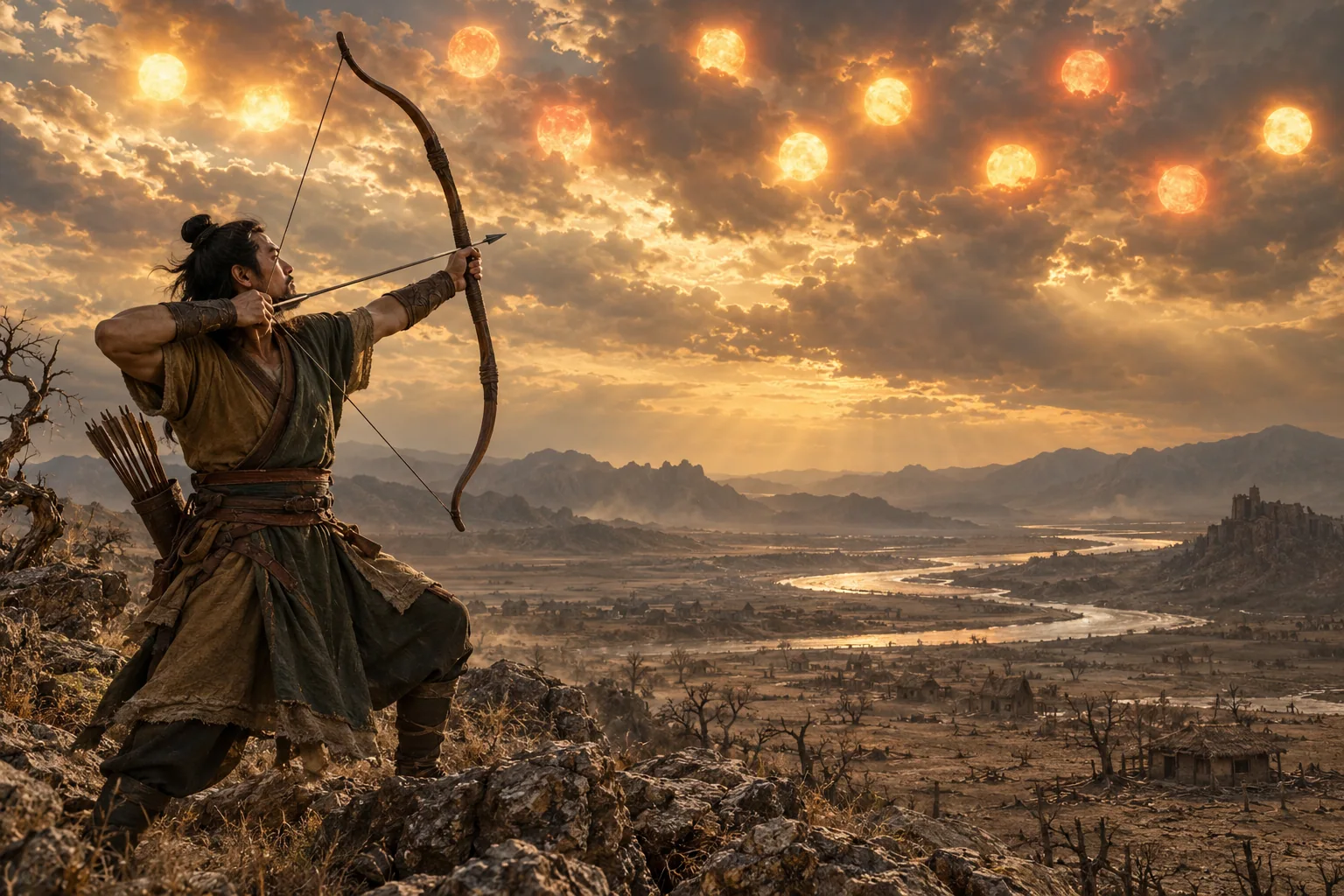
In a familiar retelling, ten suns normally take turns crossing the sky. When they rise together, fields wither and people struggle to survive. The archer Yi is called upon to end the disaster. He raises his bow against a danger that ordinary people cannot reach.
He shoots down nine suns and leaves one to provide the light and warmth the world needs. In early literary accounts, the archer’s deeds also include confronting harmful creatures. The ten-sun episode belongs to a larger picture of a hero restoring livable conditions.
Later storytelling frequently joins this rescue to Chang’e and the elixir of immortality. That creates an arc from public heroism to private separation. The solar adventure and the moon story have their own histories, even when they are told together today.
How to read it
The remaining sun matters as much as the nine that fall: the goal is a world in balance, with enough warmth for life.
Where this telling comes from
Huainanzi, Benjing records the ten suns and Yi’s deeds; the Smithsonian offers a modern educational retelling.
- Huainanzi ↗
A Han philosophical compilation. See Lanming for Nüwa, Benjing for the archer Yi, Tianwen for Gonggong, and Lanming for the moon elixir.
- Smithsonian: Moon Festival ↗
A modern educational retelling of Hou Yi and Chang’e, with Mid-Autumn cultural context.
An original introductory retelling · Sources consulted October 10, 2026.