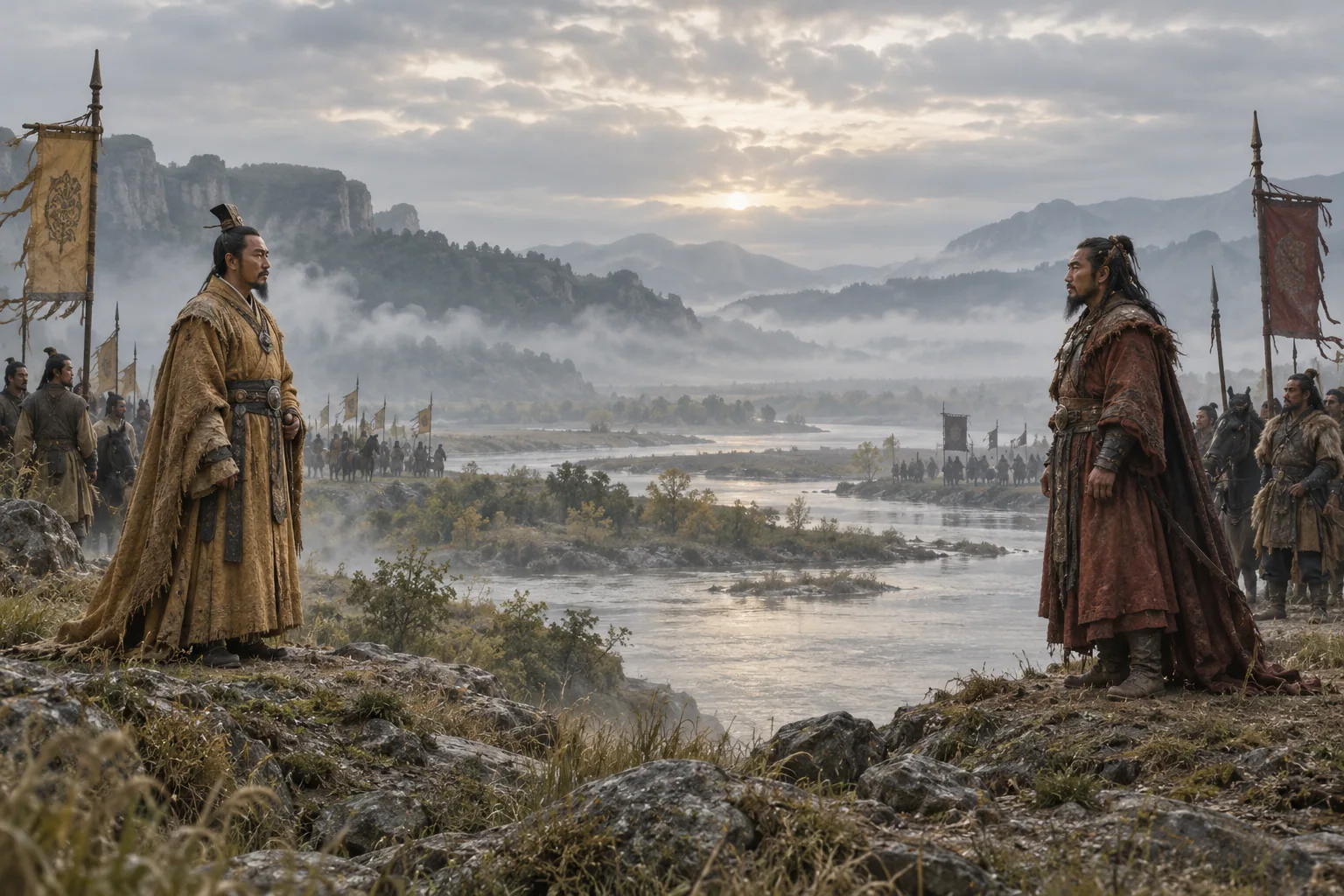
Background & setting
Huangdi, the Yellow Emperor or Xuanyuan, and Chiyou belong to accounts of the remote ancestral past. Sima Qian’s Han-era Shiji organizes them into a history of rulership; the layered Shanhaijing preserves more overtly supernatural episodes. Neither gives us a modern, independently dated account of an actual battle.
The story
In the Shiji, Chiyou refuses to submit, and the regional leaders turn to Huangdi. Huangdi gathers forces, fights at Zhuolu and kills Chiyou. Victory helps explain how Huangdi becomes the ruler accepted by other leaders. This telling emphasizes authority, alliance and the establishment of order.
The Shanhaijing gives the battle another texture. Huangdi sends Yinglong, a dragon who gathers water. Chiyou calls on the powers of wind and rain. Huangdi then brings down the heavenly woman Ba, whose presence stops the rain, allowing Chiyou to be defeated. The divine helpers cannot simply return to heaven: the consequences of war remain in the weather of the human world.
These are different ways of making a remembered conflict meaningful. Later retellings add fog, directional devices, new advisers and elaborate weapons. They should be identified as additions to particular traditions, rather than silently inserted into the earliest passages.
How to read it
The story can be read as a narrative of political legitimacy and of the dangerous power of the environment. Chiyou’s defeat in one text does not make him a universal embodiment of evil, or make modern communities descendants of opposing moral camps.
Where this telling comes from
Compare Shiji, Annals of the Five Emperors, with Shanhaijing, Great Wilderness: North. The illustration is an imagined encounter, not a recovered portrait or reconstructed battlefield.
- Records of the Grand Historian: Annals of the Five Emperors ↗
Huangdi, Yandi, Chiyou and Leizu in a Han account of the legendary past; this is not a contemporary battlefield record.
- Classic of Mountains and Seas ↗
A layered collection of geography, beings and traditions: Jingwei in the Northern Mountains; Kuafu in Beyond the Seas: North; many accounts of Kunlun and unusual creatures.
An original introductory retelling · Sources consulted October 10, 2026.